
Bursars and finance officers
Friday afternoon, the paybill and the fee register
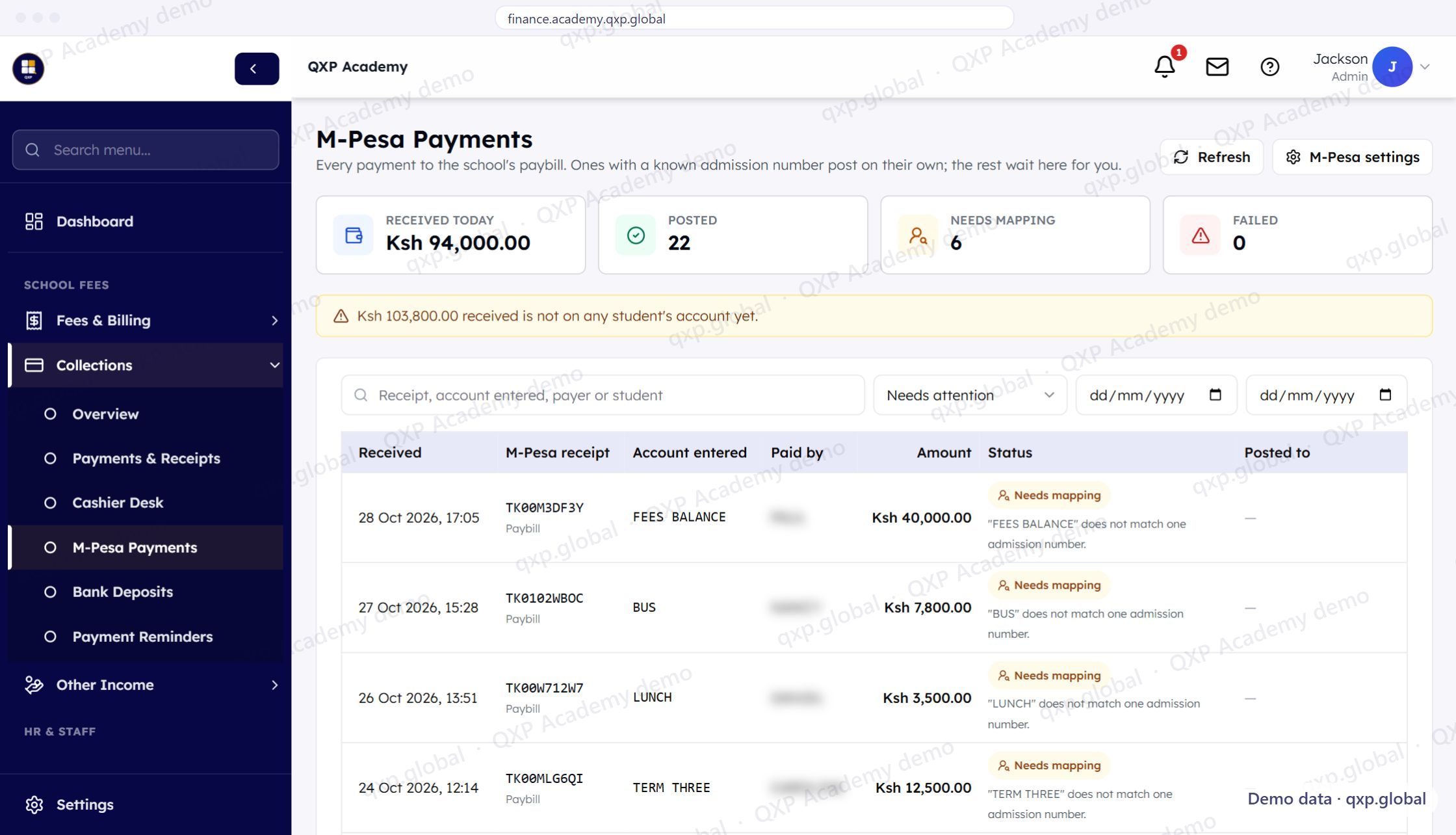
Two windows open — a paybill statement in one, the fee register in the other — and a person matching them line by line. QXP matches what it can and queues the rest with a name against it, so Friday is a short list instead of an afternoon.
What actually breaks
The four that cost a term
Matching the paybill by eye
A term's collections reconciled by reading two screens side by side. It works until the person who does it is off sick.
The payment with no reference
Paid from an uncle's phone, with a reference that means nothing. It is not lost — it is unattributed, and it stays that way until a human looks at it.
What is owed, today
The number moves when the term changes, when a concession is applied, when a credit note is raised. A spreadsheet is a photograph of a number that has already moved.
Who approved this
A requisition, a discount, a write-off. The question is rarely what was approved. It is who approved it, and whether they were the person allowed to.
On one record
The money, on the same record as the learner
The money in
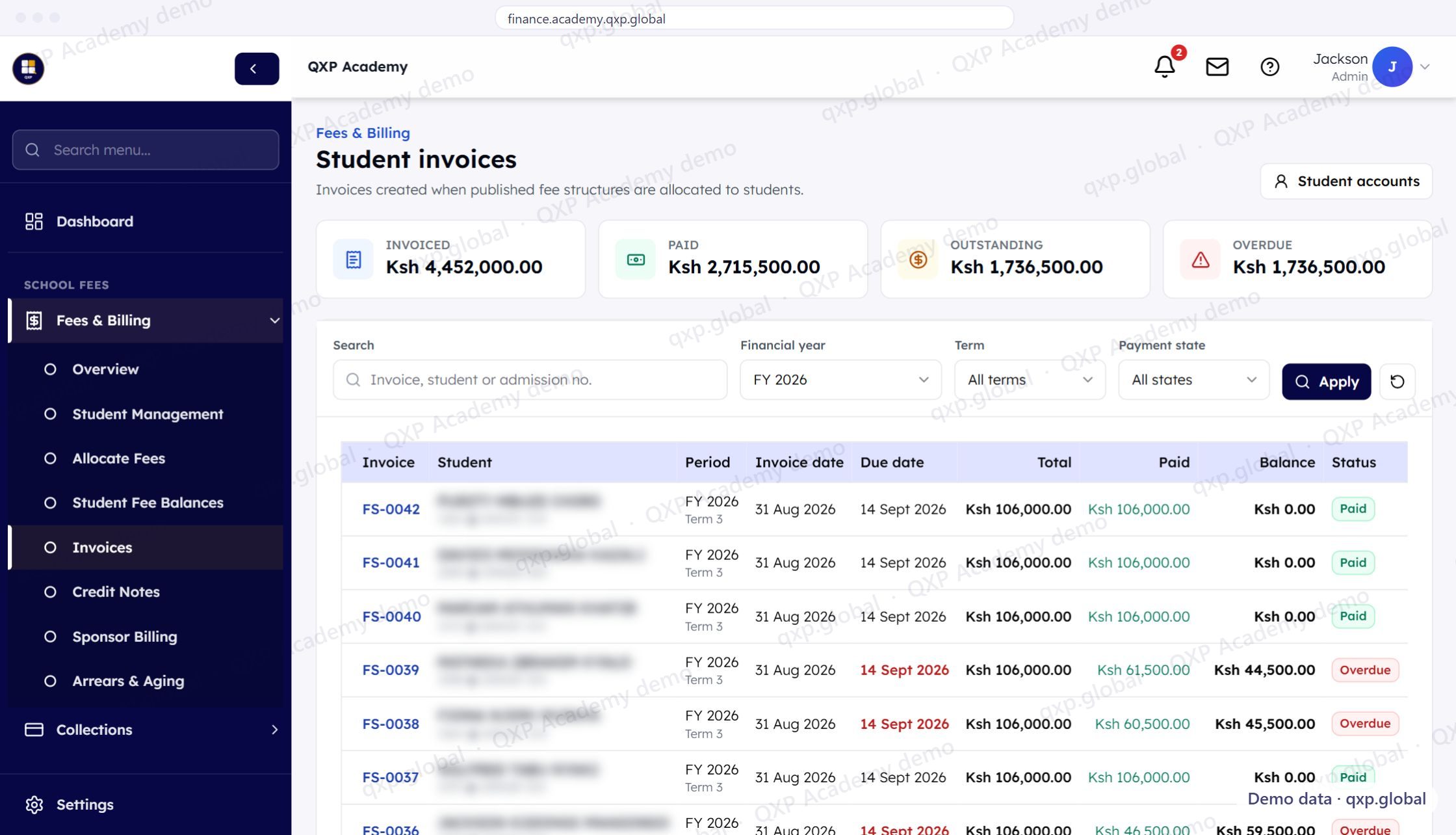
Invoices raised off the fee structure rather than typed. M-Pesa collections matched automatically, and the ones that will not match queued for a person to decide. Receipts, parent statements and arrears by class, against the register the school already keeps.
The money out, and around
Requisitions raised by one person and approved by another, with the chain recorded. Suppliers and their bank details. The uniform shop, bookshop and canteen counted as stock rather than estimated at the end of term.
The books underneath
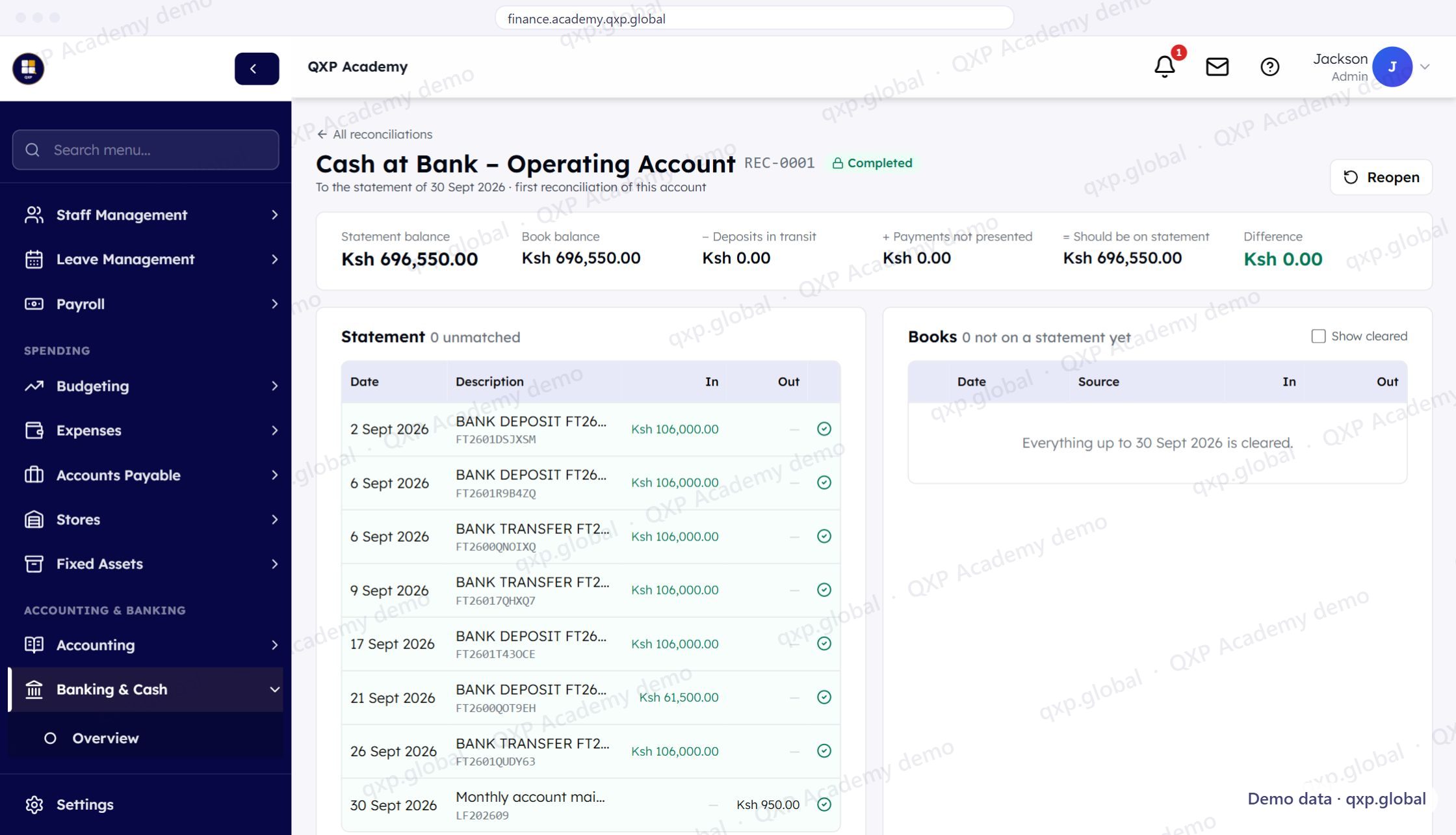
A double-entry general ledger, with treasury and banking beside it — so a term's collections are part of the accounts, not a spreadsheet somebody reconciles against them afterwards.
The back office
The screens behind the fee statement
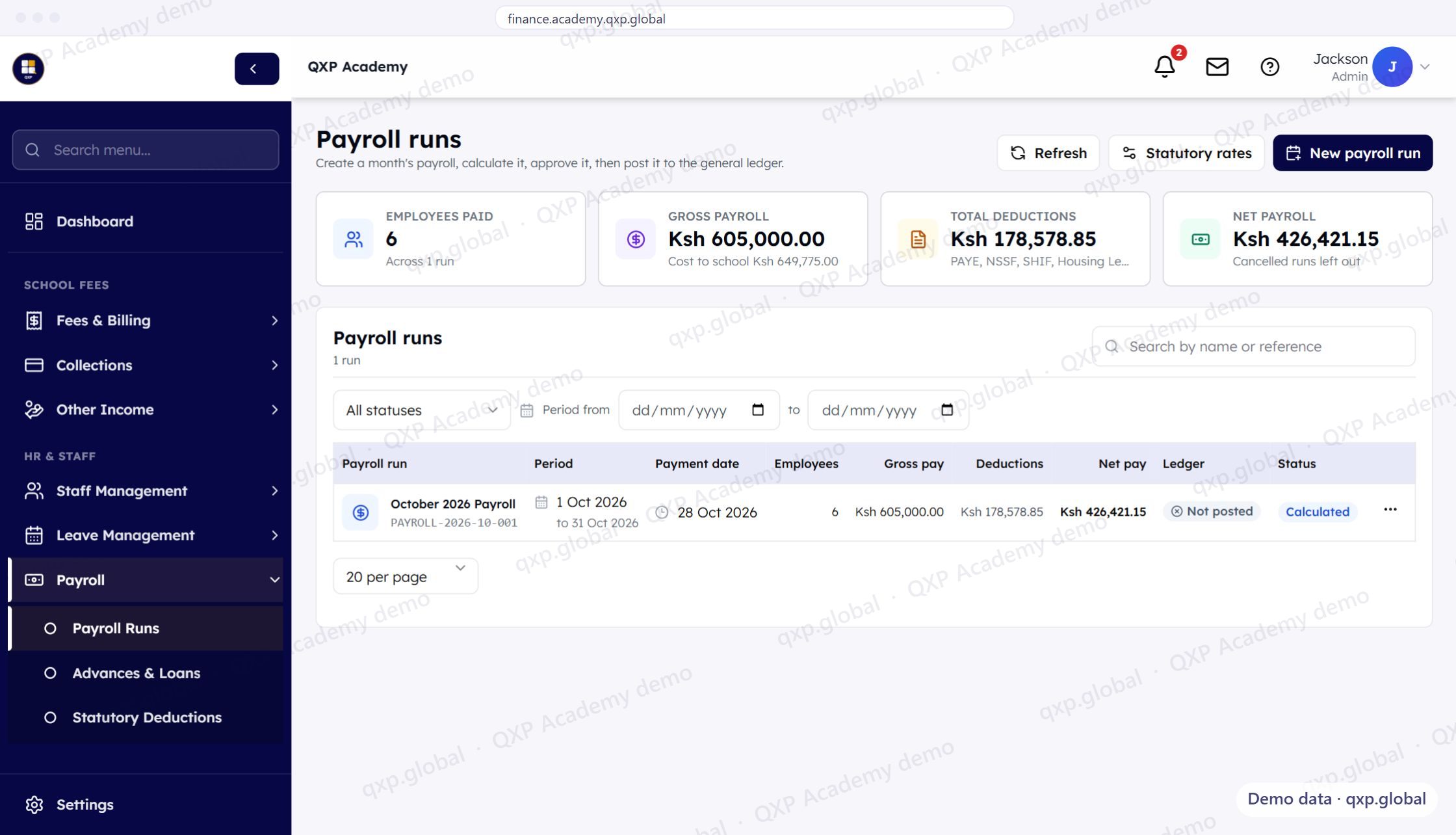
Three browser screens from the QXP Academy demo school: a bank reconciliation, the student invoices and a payroll run. They are running, and this is what they look like.
Where the work happens
You work at a desk. The parent has a phone.
The finance surface is a browser — fees administration, the ledger, treasury, procurement and the shops are screens for a desk, which is where the work is done anyway. What reaches a phone is the other side of it: the parent's own fee statement, in the app, so "what do I owe?" stops arriving as a phone call to your office.
- Fees administration
- General ledger
- Treasury and banking
- Procurement and requisitions
- Uniform shop, bookshop, canteen
- The parent's fee statement
On price, plainly
Five add-ons, each counting only its own people: Fees on Core or Plus at KES 149 per learner per term (fee structures, invoicing and M-Pesa collection; Whole School already includes it), Accounts at KES 199 per learner per term on Core or Plus (fee billing plus the books, procurement and the retail wallet), or KES 50 per learner on Whole School, which already bills fees, ECA on Core or Plus at KES 99 per learner per term (clubs and activities; Whole School already includes it), People on any package at KES 450 per staff member per term (HR, payroll and appraisal), and Transport on any package at KES 300 per learner on transport per term. The school platform itself is from KES 499 per user per term across three packages (Core 499, Plus 749, Whole School 999), VAT included - a user is a learner or a staff member, parents are free - with 15% off a full year paid upfront. What Finance covers: the ledger, treasury, procurement and retail. People covers HR, payroll and appraisal; Transport covers routes, vehicles and trip roll call. Fee structures, invoicing, receipting, statements, arrears and M-Pesa reconciliation come with Whole School, or as the Fees add-on to Core or Plus.
Show me a Friday
A 30-minute demo driven from a real fee structure and a paybill statement — ours, not yours.